Pages

Showing posts with label Birds. Show all posts

6.25.2013

TULE LAKE #6


Facing West


Sunset on "The Peninsula" and a revelation of different activities than on the east face. Less than 100 years ago the waters of Tule Lake surrounded this prominence.


Low to the ground and up close, first to be noticed are a long parade of petroglyphs. The Native Americans who predated the local Modoc and Klamath bands of tribes left these behind.


Coming by canoe, they paddled out to this place and a left what is now an indecipherable record of their existence. People who know this field of study, admit being puzzled by their meaning. When I first saw these some years ago, they were unprotected by this fence.


Watching over this heritage for perhaps as many centuries has been a series of birds. This Great Horned Owl awaits the dark to begin foraging.


For how many seasons have these big birds been here? Who knows but you can certainly pick out all the rodent skulls at the bottom of the cliff face.


Just as the sun is setting we see the return of a Prairie Falcon. There is a small lizard or rodent in its beak. 


We can't see its nest until it lands as they are pretty well hidden in the countless crevices. Suddenly the falcon flares and does a pinpoint landing at the edge its aerie. Quite a show. Quite a place.


6.21.2013

TULE LAKE #5


Facing East


There is a notable thumb of land, sometimes called the Peninsula, sometimes called Petroglyph Point, or on some maps, Castle Rock. Depending on which side you are on, catches either first or last light. Once surrounded by water, these cliffs are now high and dry.


Look one more time again at the previous picture. Towards the bottom, there is a patch of white with horizontal stripes. In 1917, Charles Coppock, born at the century mark, decided to express his frustration with being underage to join US forces during WW I. The result was this flag, dated August 15, 1917. He rowed out to a nearby spot, anchored a platform and painted what you see above. After 94 years some of the color has faded out.


When Charles Coppock returned to the area to farm, machines replaced the mules his father used. These vintage trucks spanned several decades - 30's, 40's and 50s.


Suffering from hard use, this old Ford still has most of its hardware intact.


Two more old battlewagons, a Ford and Chevy, appear to be more recently retired. Both have their license plates still attached. That is likely a field of young horseradish growing behind the trucks.


In that same early morning light that illustrated the "Flag" (above), a Canadian goose sits high above on a nearby spur of rock. Beyond, cliff swallows pepper the sky as they prepare to nest or feed their young.

6.13.2013

TULE LAKE #3


This is MY Place


No words are needed to describe who rules the roost.


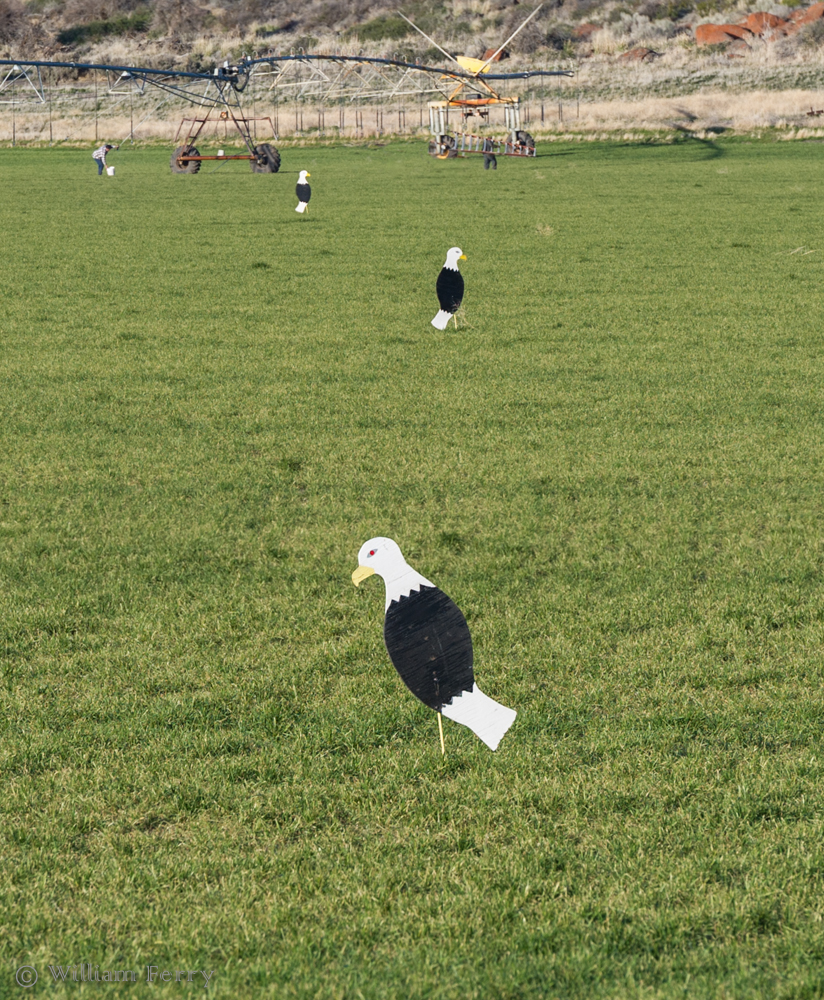
Bald eagles are so feared by some specie of bird that even poor facsimiles are enough to keep the others at bay.


One such eagle-adverse bird is the goose. The eagle in the first shot flew out over a corner of the lake and every bird on the water took flight. 
Both eagle and flock are visible here.


There are three varieties of geese in this lift off: Canadian, Snow and Tule (or White Front). 


Note not just the geese but the light and dark bands of green. This is why farmers put fake bald eagles on sprouting fields. Here the fields are managed by the Tule Lake National Wildlife Refuge. Where they feed on the Refuge isn't as critical as it is away from the lake. Theses fields are intended to host the birds. Note the contrast of white against the cliffs. Those are Snow Geese.


A quick honk of the car horn gets most of these birds to look up. Again, parts of the field are nearly barren and others are still quite green - all from where the geese choose to feed.


This appeared to be a tern but didn't match up in my iBird app. Anybody know?


6.09.2013

TULE LAKE #2


Fire!


It looks ominous. A threatening cloud of smoke rises from the flats. 


Closer, it looks like the threat is even more critical. However, this is a pretty common and everyday thing in the spring. Tractors pulling "flame cultivators" put fire to a field just prior to tilling and planting for weed control.


Not only do crops thrive in this kind of environment, so do bird populations. Above, a male Ring Neck Pheasant has his eye on the hen in upper left of the next image.


5.10.2013

WAY OUT ON WOODSON BRIDGE


The Wild Kingdom Owns It


A bit off the beaten track, Woodson Bridge is a favorite campsite.


Along the Sacramento River (east of Corning) you can choose your viewing site in a State Park, three or four private campgrounds and watch a multitude of animals and birds, including this turkey vulture.


No need of air traffic control, these swallows swarm the newer Woodson Bridge adding their own brand of bird condos.


In the dusk a river otter quietly glides towards home. We saw him about the same time each evening. So much to see, so little time.


12.18.2012

BRUNSWICK, GA #3


It IS The Water


Watching over the waterways in the pilot house is Larry Creadle, captain of the Lady Jane. The Lady Jane is a working shrimp boat.
The Captain and his crew gave us two plus hours of magic as we trawled out to St. Simon Sound and back.


Son Cliff Creadle is manning the controls that help extend or "set" the shrimp trawler's net. We did two "sets".


Marine Biologist Paul Christian makes sure the descending net and attendant lines hit the water without tangling.


 Once the net is set then everybody waits.


It takes less than 15 minutes of trawling before the catch is hauled in. What a variety of sea life that is brought on board!


A prize almost anywhere on the East Coast is the Blue Crab. However, we weren't after these beauties.


And we certainly weren't after the Horseshoe Crab that Harry was holding.


 Nix on the intimidating little Pufferfish that this woman was bold enough to hold.


Now we're getting closer - not the squid at top left or flat fish but the shrimp with the long antenna lying in the background of the the catch deck. 
We came for the shrimp and they were plentiful.


Though fresh shrimp for all was the big draw (mate Cliff Creadle took on the added duty of boiling and serving them to us), I found the by-catch much more interesting, as you might tell from all the other pictures above. Look in the mouth of the Spotfish above. Do you see the critter with two little black eyes?


Here are the two again. The small multi-legged creature on top of the Spotfish is a parasite that is quite commonly found in residence inside a number of fish that inhabit the backwaters of the Georgia sloughs.


 Our constant companions were the seagulls and pelicans looking for handouts. Like a character from Nemo, you can almost hear this one say: "MINE!" Not this time. Any tasty shrimp were ours.


12.11.2012

GRAY GEORGIA


On A Gray Day


We were told that Georgia has more marsh land than any other state but proving it online was too much of a challenge. One thing for sure, our marine pathway through all the salt marshes was serpentine. No sooner did we traverse one section of the Intracoastal Waterway only to make a near U-turn and then nearly repeat the same route, albeit 100 yards further east. Above is one such segment as we snaked our way though the considerable wetlands of Georgia.

Though common but well named, Snowy Egrets pick tidal scrub growth to fashion their nests and raise their young. Scientists tell us that these egrets only recognize their mate by a "greeting dance" they do when returning to the nest, no matter how long they've been together. What do scientists know - maybe the birds are just happy to see their relief return.

At times we seem to cruise in remote backwaters but there is a actually a fair amount of traffic on the ICW. 
This is the tug LouAnna Guidry pushing two small barges, one of which is a fuel barge.


 Approaching Sapelo Island, the lighthouse is as much cosmetic as it is practical now that shipping follows other waterways.

Sapelo Island is 97% owned by the State of Georgia so I can only guess that this is a part of a tidal catwalk for the University of Georgia's Marine Biology Institute there.

This is the only way on and off Sapelo Island. Once established as a slave plantation, the island has gone through several other owners before the State of Georgia took over. The last major owner was R. J. Reynolds, Jr, scion of the tobacco empire. His mansion is now a Georgia State Park.

These twenty-plus hardy souls are coming back to the American Spirit after an afternoon on Sapelo Island. Of all the many fine field trips and excursions, this turned out to be the least popular. The weather and limited facilities on Sapelo conspired to produce something less than an optimal experience. The R. J. Reyolds's mansion was rented out, thus closed, the school bus that took them around was a tad uncomfortable and the wind and rain made moving about outside uncomfortable.

Despite the weather, there were always adventuresome souls who loved being outdoors. Get a little exercise and watch the world go by the Intracoastal Waterway - this is Janine who didn't let any weather bother her.


11.28.2012

Hilton Head, SC


Vacationer's Mecca


As a resort Hilton Head is only 50 years old, and the island isn't really technically considered as one of the barrier islands but rather part of a glacial moraine and a sea island from long ago deposits. What it definitely is is a year round playground.

There are at least 2 dozen golf courses on this 55 square mile island with many of the courses garnering considerable fame in the golf world for hosting some of the biggest PGA tournaments. 


Come sit a spell. There are 15 gated communities on the island so that should tell you something about the target age group.

Popular with the avian set, this flock of Brown Pelicans are beginning to display their breeding plumage wherein the head coloring becomes more pronounced. The cormorant at far right is just plain jealous. The range of tides can be seen on the seawall. Tidal swings can hit 10'.


 Garden neighbors seem pretty peaceable don't they? There were certainly enough of the little red flowers to go around

This is a Fiddler Crab. It is the mark of the specie to have one claw markedly bigger than the the other. Large claw distribution can be 50-50 right or left. They are a good indicator of marsh health, which is their habitat.

As small as they might be, they produce these oversized spheres of waste. Known as "detritivores", the fiddler crabs use their claws to bring any kind of detritus to their mouths. The sediment left ends up being formed into the balls. 

Ralph Eschelman did a great job of describing the history, culture and natural life as our cruise nosed through the ICW of South Carolina, Georgia and N. Florida. Did he find an old football helmet here? No, it's the shell of the prehistoric looking Horseshoe Crab. More on that crab on a future post. Hopefully Ralph will give me high marks for getting what he told us this day correct. Any errors are mine and not his : > )